
Cross-border E-commerce: Overseas Warehousing (Beginner’s Guide)

This is an introductory article designed for those who are not yet familiar with the field of cross-border e-commerce overseas warehousing. If you are already working in the industry, you may still find this piece useful—perhaps as a training resource for onboarding new team members.
Order fulfillment in cross-border e-commerce refers to the entire sequence of processes that occur after a customer places an order on a platform like Amazon or eBay. In layman’s terms, it encompasses everything that happens after a user places an order: how the merchant responds, how the order is transmitted to the warehouse, how the warehouse processes and ships the goods, how the shipment is tracked, and how post-purchase issues (such as returns or customer service) are handled.
Cross-border e-commerce orders do not necessarily require the use of an overseas warehouse; they can also be shipped directly from a domestic warehouse using specialized small-parcel logistics services. However, the overseas warehousing model is currently booming, with more and more merchants opting to stock inventory abroad in advance. Furthermore, the "last-mile" delivery capabilities provided by overseas warehouses significantly enhance the user experience. Therefore, understanding how overseas warehouses operate is highly beneficial for grasping the broader landscape of cross-border e-commerce order fulfillment.
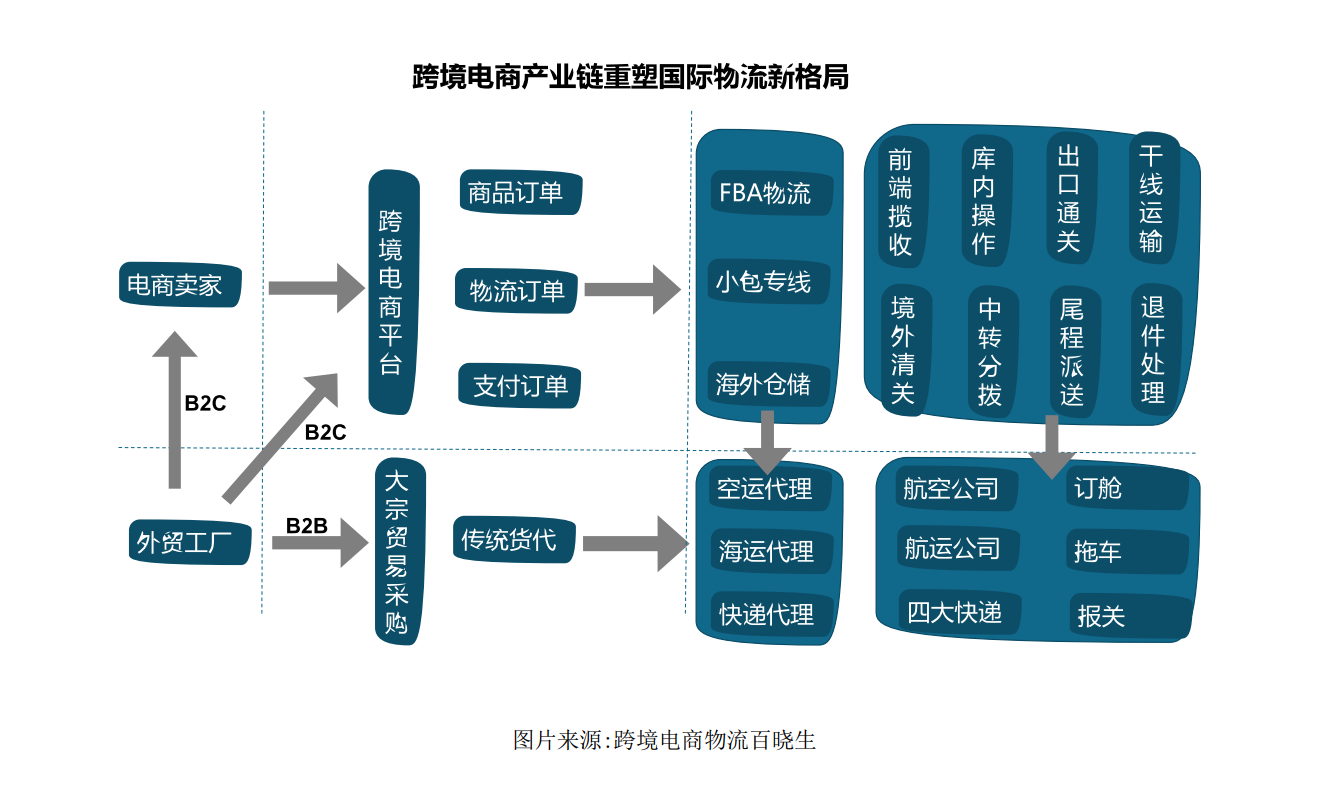
An overview of the full scope of cross-border e-commerce order fulfillment.
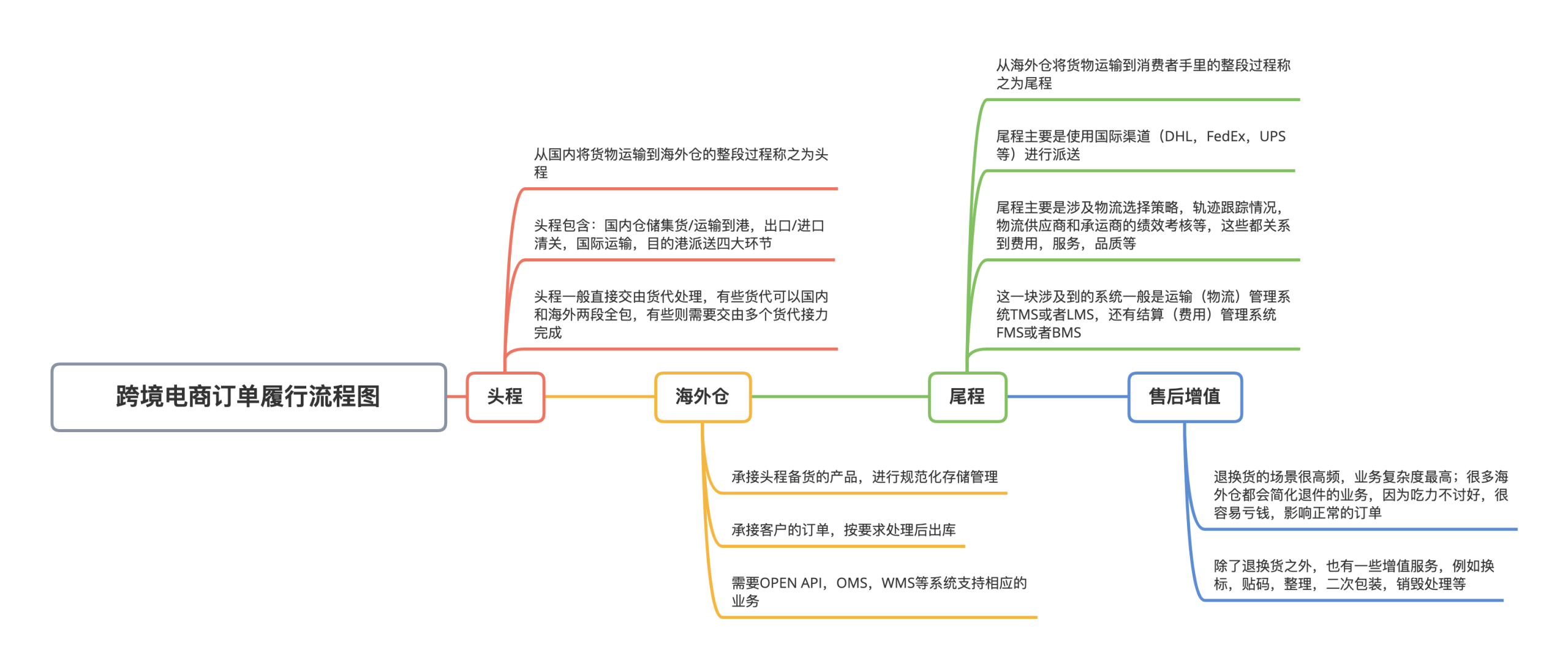
As shown in the diagram above, overseas warehousing operations can be broadly categorized into four main modules:
- Inbound Logistics (First-mile/Main-haul)
- Overseas Warehousing
- Last-mile Delivery
- After-sales/Value-added Services
Next, we will provide a brief overview of these four core modules to help you build a foundational understanding.。
Inbound Logistics (First-mile/Main-haul)
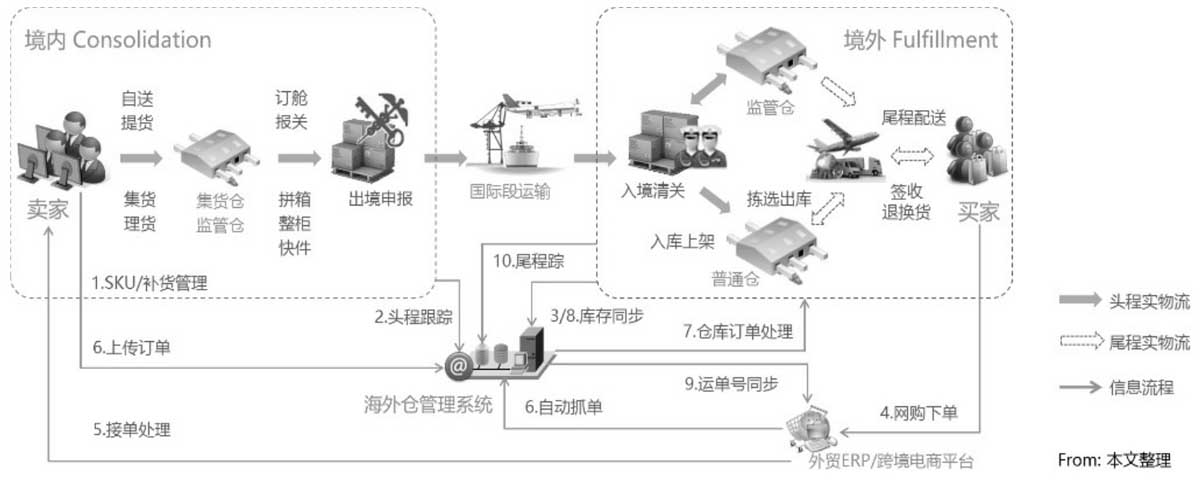
The entire process of transporting goods from a domestic location to an overseas warehouse is known as "first-mile" (inbound) logistics. To fulfill orders from an overseas warehouse, a large volume of stock must be transported there in advance—this is the core objective of the first-mile phase. If these terms are unfamiliar, please refer to the diagram below to better understand the operational workflow.
Inbound logistics generally encompasses four stages: transport from the origin (e.g., China) to the port of departure, international transit, export/import customs clearance, and final transport from the destination port to the warehouse. These stages are typically handled by freight forwarders; therefore, while working in the overseas warehousing sector, one only needs a general understanding of customs documentation and procedures—in-depth technical knowledge is not required.

Overseas Warehousing
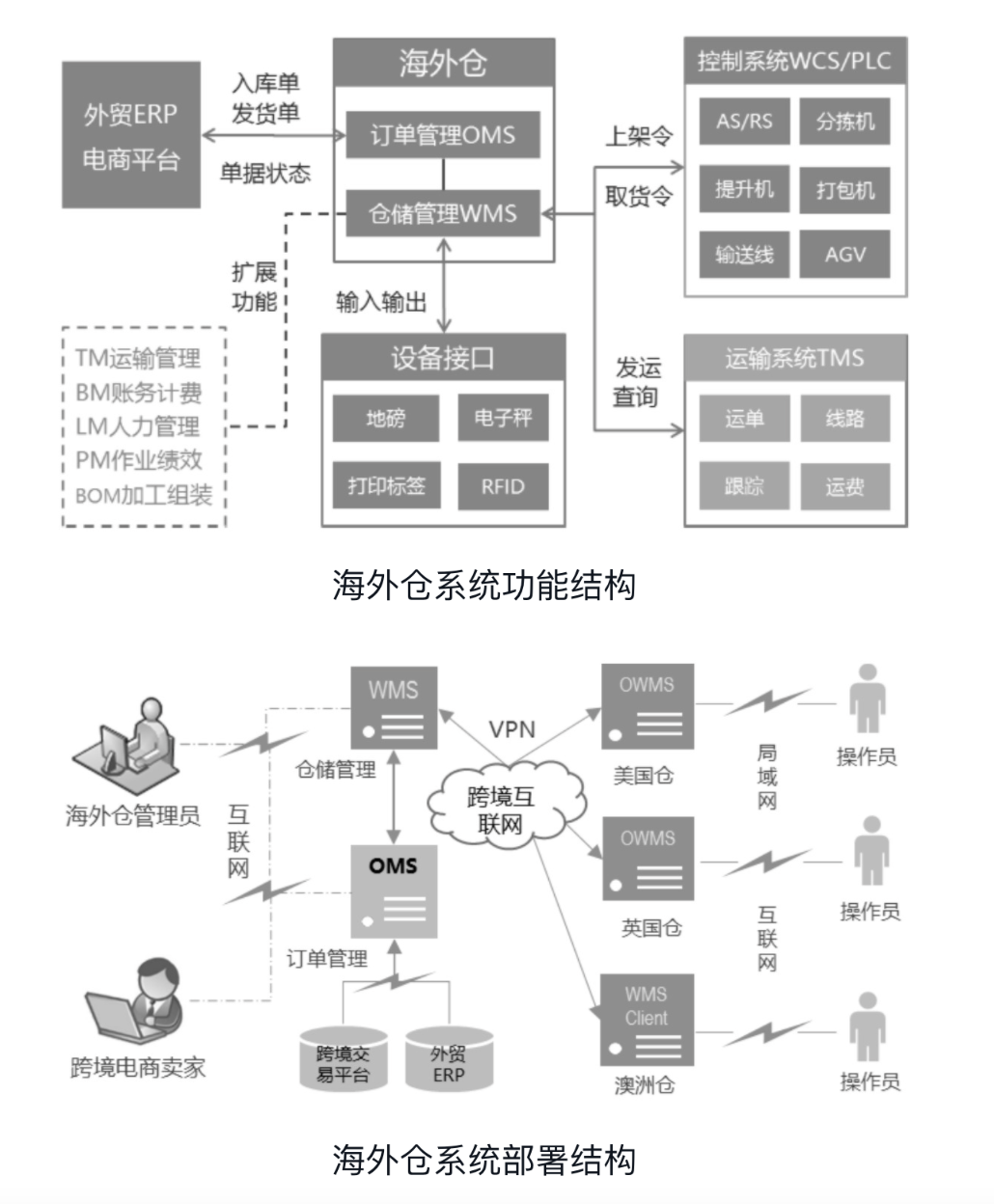
The scope of overseas warehousing is quite broad; if we define it narrowly—focusing strictly on operational management within the warehouse—then the WMS (Warehouse Management System) takes center stage. Warehouse Management Systems (WMS) for overseas warehouses share many of the same modules and frameworks as those used domestically. The primary differences stem from cultural nuances, time zone variations, distinct business models, and the integration with "last-mile" delivery services—all of which have given rise to specialized features unique to overseas WMS solutions.
In simple terms, the functionality of an overseas warehouse can be categorized into three major modules: inbound operations, outbound operations, and internal warehouse operations.
Inbound logistics relates to the process of moving goods from the origin country into the overseas warehouse. Outbound logistics begins when orders are retrieved or received from e-commerce platforms or an ERP system; after undergoing a series of pre-processing steps, the orders are routed to the warehouse for fulfillment—a process that includes wave planning, picking, sorting, verification, packing, weighing, and final dispatch. Warehouse operations consist of essential, foundational services required to support storage activities, such as bin/location management, stock relocation, inventory counting (stocktaking), and general inventory management, alongside various system configurations and logical settings.
Last-mile Delivery
The process of transporting goods from an overseas warehouse to the end consumer is known as "last-mile" logistics. This involves a logistics provider picking up the items from the warehouse and delivering them to the consumer. Since the warehouse is located locally, the last-mile delivery typically utilizes established domestic logistics carriers—for example, FedEx Ground or USPS in the United States, and DHL, UPS, or DPD in Europe.
A single overseas warehouse typically integrates with multiple logistics channels. Depending on factors such as the destination country or state, the order value, and the specific service requirements of the cargo owner, the system selects an appropriate logistics channel—a concept commonly referred to in the industry as a "logistics product." In essence, the overseas warehouse consolidates various logistics channels into a unified "product" that cargo owners can choose from. The system then applies specific logic to select the most suitable logistics product and assigns it to the corresponding order.
After-sales/Value-added Services
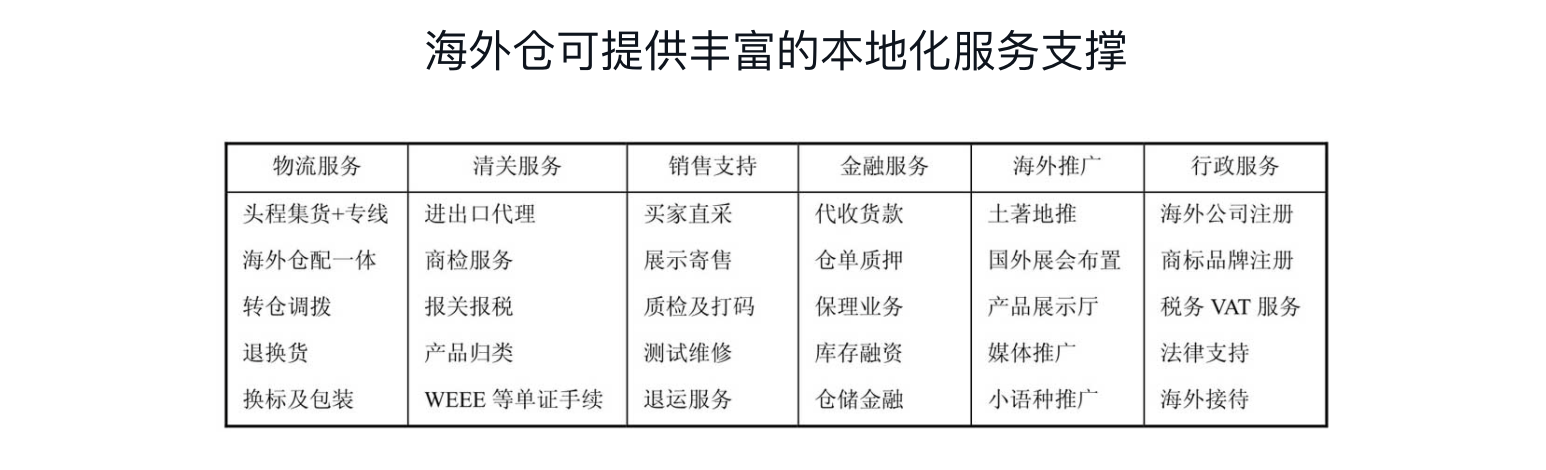
Outbound order fulfillment is inevitably accompanied by reverse logistics (after-sales issues), which necessitates specific services from overseas warehousing providers. Handling returns is a notorious challenge in this industry—partly due to the inherent complexity of the processes, and partly because consumer protection laws in Europe and the United States lead to a high volume of RMAs (Return Merchandise Authorizations).
Beyond post-purchase services like returns, exchanges, and repairs, overseas warehouses also offer services such as relabeling, barcode application, repacking, and inventory transshipment. These are collectively known as "value-added services." While they technically fall under the "overseas warehouse" module, I have separated them here to discuss them in greater detail.
Introduction to systems for overseas warehouses.
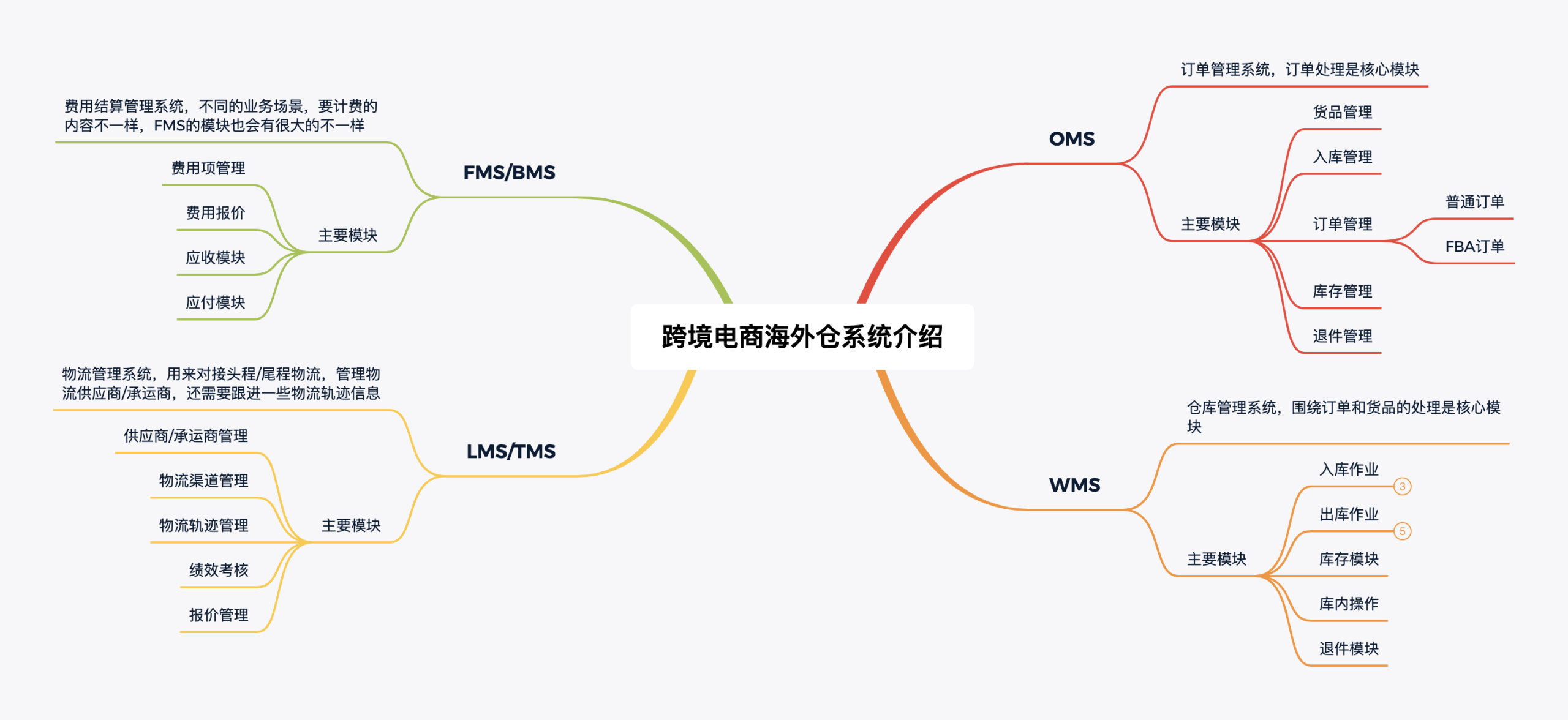
Typical overseas warehouse systems generally consist of four components: OMS (Order Management System), WMS (Warehouse Management System), TMS (Transportation Management System), and BMS (Billing/Business Management System). The core modules and functions of each are highlighted in the diagram above; you may consult further resources for more detailed information. Some acquaintances have previously asked me about developing their own WMS; however, our discussions revealed that many tend to oversimplify IT systems—assuming that a WMS paired with an OMS or ERP is sufficient. In reality, such operations are supported by a much broader ecosystem of interconnected systems. If any of these components are missing, the resulting system will feel awkward to use or lack sufficient power.
Common cross-border e-commerce ERP systems—such as Mabang, Dianxiaomi, Yicang, Saihe, and Tongtu—do include some warehouse management features. However, in practice, you will find that they operate quite differently from the specific requirements of overseas warehousing. Therefore, if you are considering purchasing such an ERP system to manage overseas warehousing—whether for serving clients or for your own operations—be aware that significant risks are involved. I advise those looking to enter this field to conduct thorough research and seek professional consultation; do not dive in blindly.
Additional Information
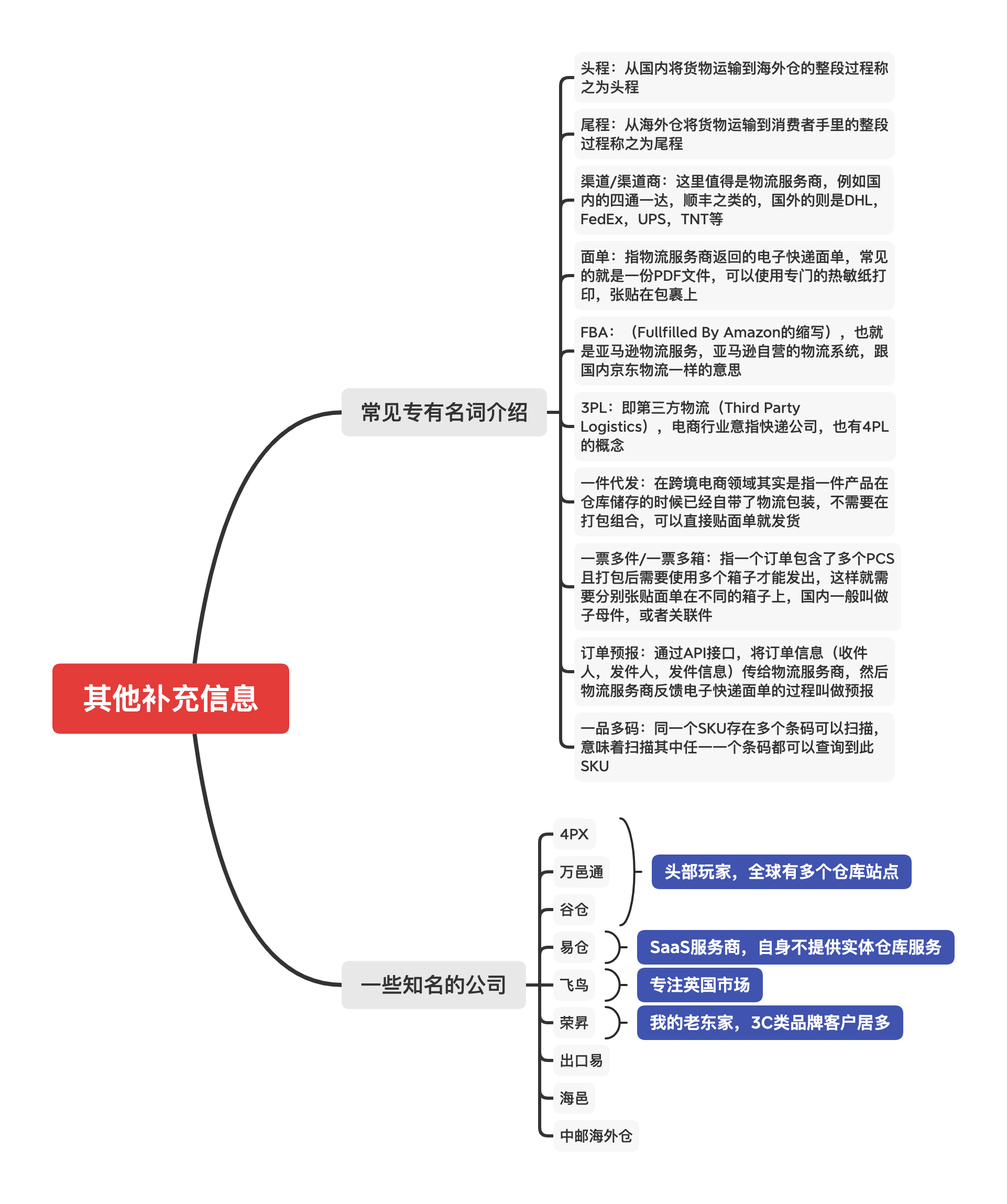
At the end of this article, I have included a glossary of specialized terms to help you better understand industry-specific jargon and vocabulary used throughout the text.
When selecting an overseas warehouse, consider various factors. Well-known, large-scale warehouses offer certain advantages, but they may also come with distinct drawbacks. Conversely, specialized (niche) warehouses may have specific limitations, yet they often excel within their particular areas of expertise.
Note: The illustrations used in the sections on "First-Mile Logistics," "Overseas Warehousing," "Last-Mile Delivery," and "After-Sales/Value-Added Services" are taken from the book *Cross-Border E-Commerce and International Logistics: Opportunities, Models, and Operations* (available on WeChat Reading). The author has also written another book, *Cross-Border Logistics and Overseas Warehousing: Markets, Operations, and Technology*, which I have recommended in previous articles. These books are far superior to my own summary; I am essentially "standing on the shoulders of giants" here. My thanks to the author, Sun Tao.